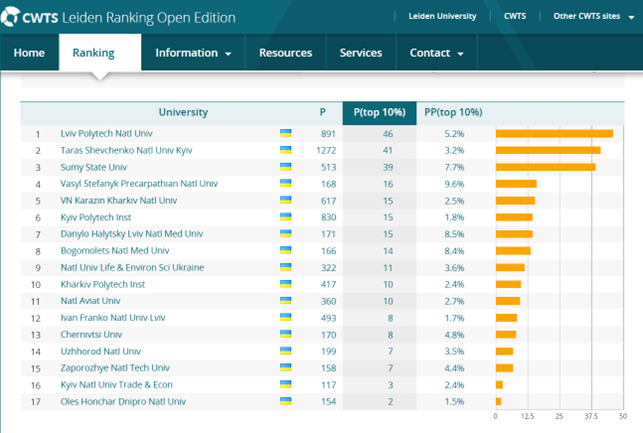

Vasyl Stefanyk Carpathian National University is among the few HEIs in Ukraine represented in the CWTS Leiden Ranking Open Edition 2025 – an international bibliometric ranking of universities that assesses scientific impact, collaboration, and open access based on data on scientific publications.
The CWTS Leiden Ranking Open Edition is an open version of the Leiden Ranking, launched in 2024. It is based on open bibliographic data from OpenAlex and, unlike the traditional version, supports a more transparent and inclusive approach to analyzing the global university landscape.
In 2025, the Open Edition covers over 2,800 universities worldwide. In the sample ordered by P(top 10%), KNUVS ranks 4th among Ukrainian higher education institutions represented in this section of the ranking.
The P(top 10%) indicator means the number of university publications that, compared to other publications in the same field and in the same year, are among the 10% most cited. This criterion is important because it reflects not only the number of scientific publications, but above all their international scientific impact.
A high indicator indicates that the university’s research results are actively cited by the global academic community, and therefore are notable, relevant, and in demand in relevant scientific fields.
Importantly, the Leiden Ranking uses normalization by field and year of publication for scientific impact indicators, and does not take into account self-citations by authors. This allows for a more accurate comparison of the results of universities operating in different scientific fields.
At the same time, the Leiden Ranking should be interpreted responsibly: it is not a “general ranking of the best universities”, but an analytical tool for assessing individual dimensions of scientific activity – in particular, citations, collaboration, and open access.
For Vasyl Stefanyk Carpathian National University, a high position in the ranking is a confirmation of the quality of scientific research, the growth of international visibility of publications, and the strengthening of the university’s integration into the global research space.